
























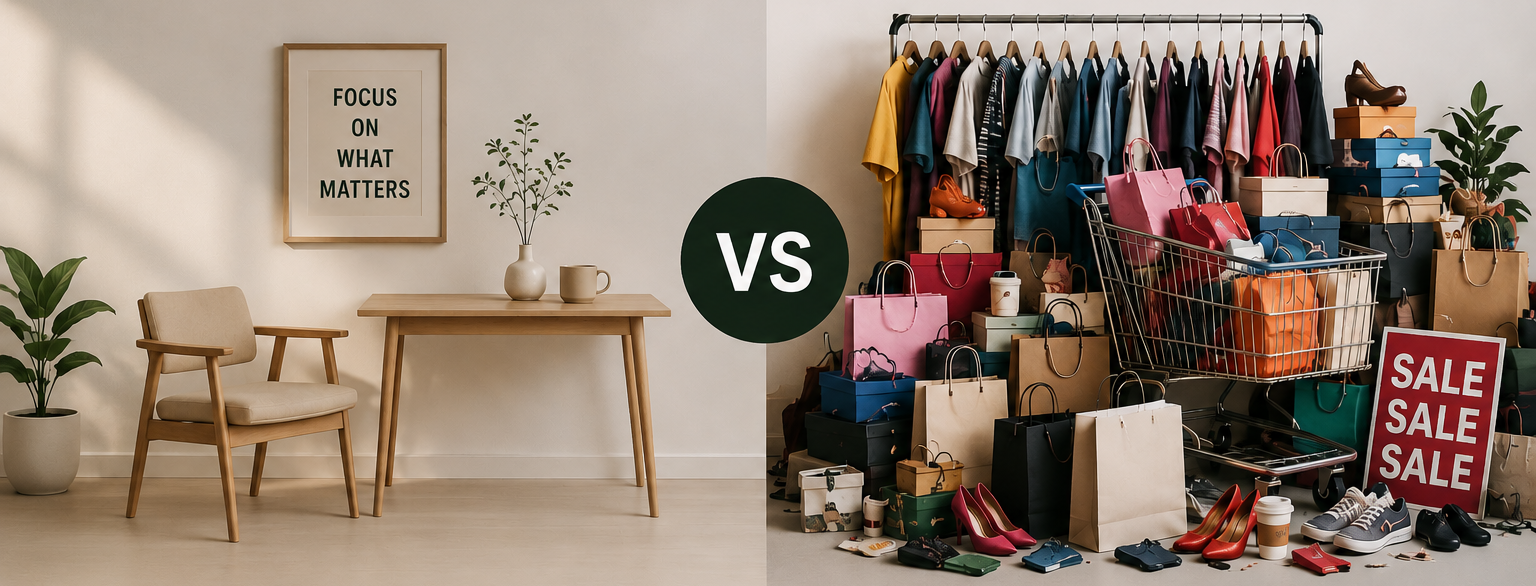
Minimalism and consumerism represent two very different approaches to life and possessions.
🌿 Minimalism
Minimalism focuses on owning and consuming only what adds value to your life. It encourages intentional choices, simplicity, and prioritizing experiences over material things.
Examples:
- Buying only what you need
- Choosing quality over quantity
- Decluttering unnecessary items
- Saving money for meaningful goals
🛍️ Consumerism
Consumerism is the tendency to acquire more goods and services, often beyond basic needs. It is driven by advertising, trends, and the desire for constant upgrades.
Examples:
- Impulse buying
- Following every new trend
- Frequently replacing items that still work
- Measuring success through possessions
⚖️ Key Differences
| Minimalism | Consumerism |
|---|---|
| Focuses on needs | Focuses on wants |
| Values simplicity | Values accumulation |
| Reduces clutter | Often creates clutter |
| Encourages mindful spending | Encourages frequent spending |
| Prioritizes experiences | Prioritizes possessions |
💡 Final Thought
Minimalism asks, “Do I really need this?”
Consumerism asks, “What else can I buy?”
The goal of minimalism is not deprivation—it’s creating space for what truly matters. By owning less and choosing intentionally, you can gain more time, freedom, and peace of mind. 🌱✨











swEaFRJgqCrkhsfJygAnHqCX
RnEbyTHHPjYoinKqZ
zSJDAxMIICTVGqbKJlCsX
hGooOwOZwKHkfoWinygVI