



















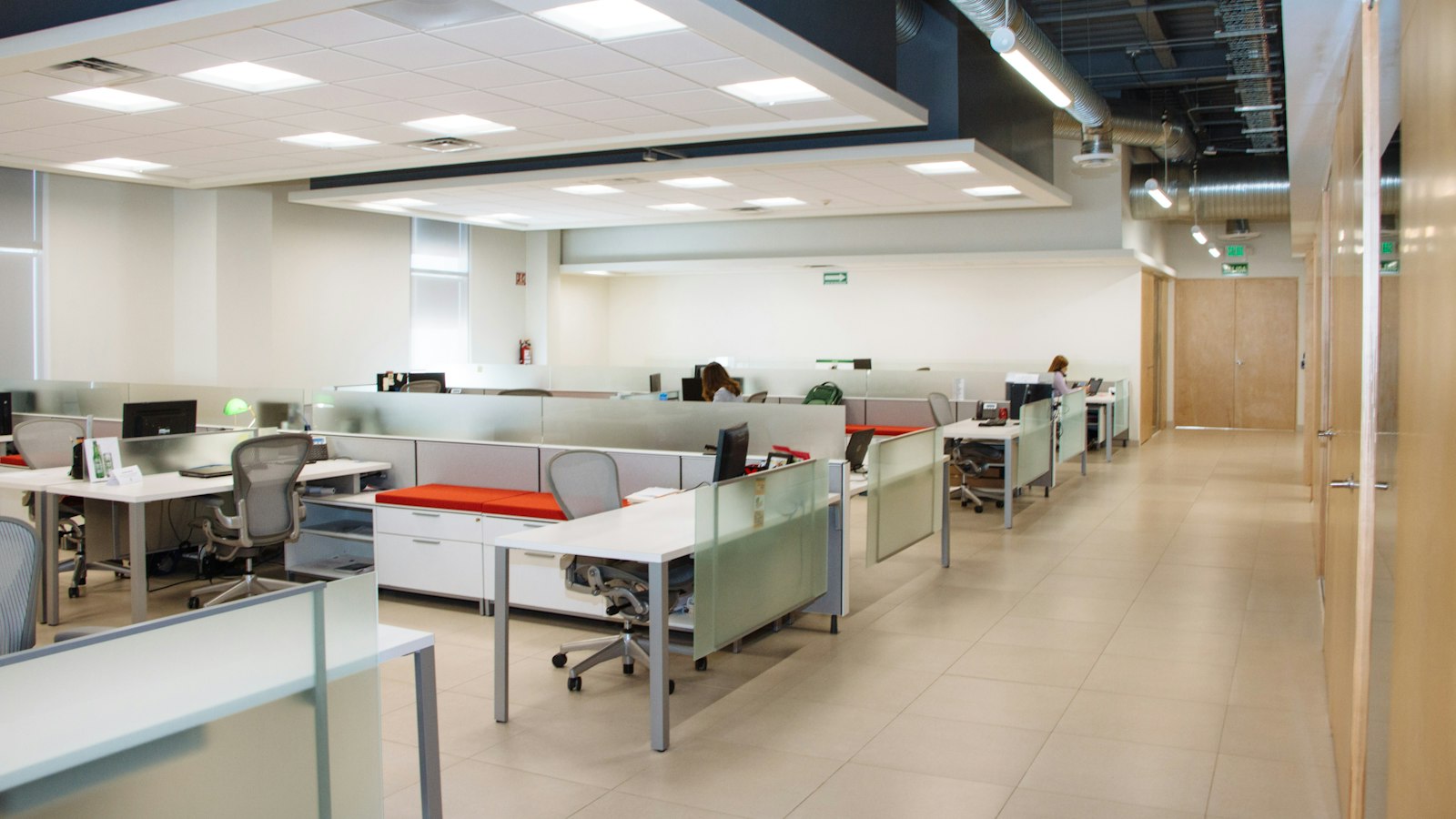
The justification for knocking down the walls has been the same since the beginning: people will talk to each other more. Remove the barriers, remove the friction, and collaboration follows.
In 2018, Ethan Bernstein and Stephen Turban published the study that finally tested it properly, in Philosophical Transactions of the Royal Society B. Two Fortune 500 headquarters, each moving employees from wall-bounded cubicles to open floors. Employees wore sociometric badges with infrared sensors that detected face-to-face interaction; email and instant messaging were captured from company servers. Measurements were taken before the redesign and again after.
What the sensors recorded
At the first company, 52 participants were tracked across 15 workdays before and 15 workdays after. The corpus ran to nearly 97,000 face-to-face interactions, 84,000 emails and 25,000 instant messages.
Face-to-face interaction fell from roughly 5.8 hours per person per day to roughly 1.7 — a 72% decline. At the second company, analysed across 1,830 employee pairs over eight-week windows, the fall was between 67% and 71%. Both results were statistically robust.
Electronic communication rose. Emails sent were up 56% at the first company, instant messages up 67%, IM word count up 75%. At the second company, email rose between 22% and 50%.
The authors’ proposed mechanism is worth quoting in substance: rather than have a conversation in front of an audience of peers, an employee looks around, sees the person is at their desk, and sends an email instead. Removing the walls did not remove the desire for privacy. It relocated the conversation to a channel that still had some.
The caveat the coverage drops
This study is cited everywhere as proof that open offices destroy productivity. It did not measure productivity. Not at either company, not in any form.
The paper’s only statement on the subject is second-hand and qualitative: executives at the first company reported to the researchers that productivity, by their own internal performance metrics, had declined after the redesign. That is an anecdote relayed by interested parties, and the authors present it as such.
Two other limits belong in any honest account. Participation was voluntary and covered roughly 40–45% of the affected employees, and there was no control group — nothing rules out a company-wide change over the same period. The authors also state that the underlying data cannot be released, because of confidentiality agreements with the firms.
There is one more disclosure that rarely appears. The badges came from Humanyze, and the most-cited follow-up article — a 2019 Harvard Business Review piece with Bernstein — was co-written by Ben Waber, Humanyze’s co-founder and president. Its central recommendation is sensor-based workplace measurement. That does not invalidate the 2018 findings, which stand on their own design. It is simply something a reader should know.
The trade-off, priced
The strongest evidence on whether the open office is a good bargain comes from a much larger dataset. Jungsoo Kim and Richard de Dear analysed 42,764 survey responses across 303 office buildings from the Center for the Built Environment’s post-occupancy database, published in the Journal of Environmental Psychology in 2013.
Their regression weighed the benefit the open plan is supposed to deliver against the costs it imposes, in the same model.
Their conclusion, in their own words, is that the gain in satisfaction from easier interaction in open-plan layouts failed to offset the losses from noise and lost privacy. The models explained 63–65% of the variance in overall workspace satisfaction, so this is not a marginal statistical artefact.
A systematic review by James, Delfabbro and King, published in SAGE Open in 2021, screened 10,242 papers and retained 31 that allowed a direct comparison between open-plan and single-occupant enclosed offices. Every one of the nine studies measuring noise favoured closed offices. All ten measuring privacy favoured cellular designs. Of 25 outcome subcategories, exactly one favoured open plan: proximity to colleagues.
The origin story is not what you think
The open office is usually described as a cost-cutting scheme dressed up as a collaboration strategy. The first half of that is an anachronism.
The concept — Bürolandschaft, office landscape — came out of a West German consultancy around 1960, founded by the brothers Eberhard and Wolfgang Schnelle. Their method was genuinely empirical: they mapped the frequency of paperwork and face-to-face exchange between departments and positioned desks according to the measured interaction patterns, treating the office as an information-processing system. The stated rationale was communication optimisation. By 1972, roughly 40,000 people across nine countries worked in offices they had designed.
The cost logic arrived later, and mostly in America. CoreNet Global’s own 2012 survey of more than 465 corporate real estate managers recorded average space per office worker falling from 225 square feet in 2010 to 176 in 2012, with 151 projected by 2017. The share of firms at 100 square feet or less was expected to rise from 24% to 40%. Cost containment was named as a driver by the industry itself.
So the honest history is stranger than the cynical one. The open office began as a measurement, and was then adopted at scale for reasons that had nothing to do with the measurement, and defended for sixty years using the original justification.
Does anything fix it?
Activity-based working — no assigned desks, a variety of zones for different tasks — is the industry’s current answer. The best test of it is a controlled Swedish study by Haapakangas and colleagues in 2019: 408 respondents, four offices relocating to activity-based workplaces plus one control office that did not move, with follow-ups at 3 and 12 months.
Satisfaction with communication and sense of belonging to a community had decreased at both follow-ups. The negative effects on social support and job demands concentrated among employees who had moved out of private offices; people moving from open plan into activity-based space fared better. Notably, differences between sites were substantial, which suggests implementation quality mattered more than the label.
What nobody has measured
Here is the genuinely uncomfortable finding. After sixty years and an unknowable sum spent on fit-outs, there is still no clean controlled evidence about whether open plan makes work better or worse.
The systematic review screening ten thousand papers could not find a single productivity study favouring open plan — and also could not produce clean causal evidence against it. Most of the 31 included studies were cross-sectional, which cannot separate the office from the kind of person who works in it. People in private offices are systematically more senior, and seniority independently predicts absence, autonomy and satisfaction.
And the interaction-quality question is open on its own terms. If 5.8 hours a day of face-to-face contact was substantially interruption, a fall to 1.7 is not self-evidently a loss. The badges recorded that people were talking. They could not record whether it was worth it.
That is the real story: a decision this expensive, this universal, and this easy to test has been made overwhelmingly on intuition. The one company that measured before and after found its employees had stopped talking to each other — and then, according to its own executives, stopped measuring.
Sources
- Bernstein ES, Turban S. The impact of the ‘open’ workspace on human collaboration. Philosophical Transactions of the Royal Society B 2018;373(1753):20170239.
- Kim J, de Dear R. Workspace satisfaction: The privacy-communication trade-off in open-plan offices. Journal of Environmental Psychology 2013;36:18-26.
- James O, Delfabbro P, King DL. A Comparison of Psychological and Work Outcomes in Open-Plan and Cellular Office Designs: A Systematic Review. SAGE Open 2021.
- Haapakangas A, Hallman DM, Mathiassen SE, Jahncke H. The effects of moving into an activity-based office on communication, social relations and work demands. Journal of Environmental Psychology 2019;66:101341.
- CoreNet Global. Office Space Per Worker Will Drop to 100 Square Feet or Below. Survey release, 28 February 2012.