












General information, not medical advice. Persistent eye discomfort, headaches or vision changes warrant an appointment with an optometrist or ophthalmologist rather than a purchase.
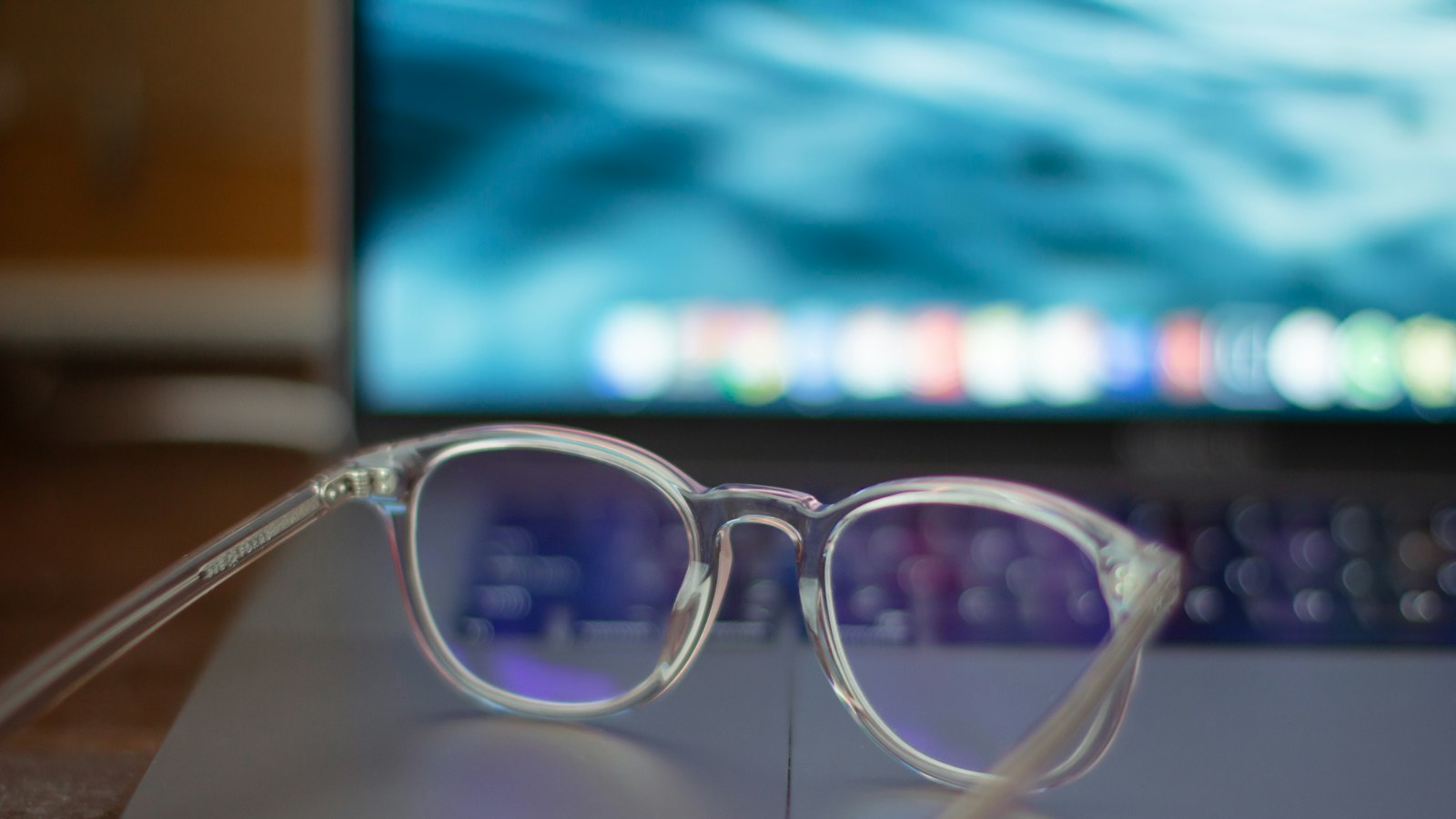
Blue-light filtering lenses went from a niche optical product to a default upsell in about a decade. Buy glasses online and the blue-light coating is offered as a near-automatic add-on; buy them without a prescription and an entire category of eyewear exists for people with perfectly good vision who spend a lot of time at screens.
In August 2023, the Cochrane Eyes and Vision group published a systematic review of the randomised evidence. Seventeen trials, 619 participants, six countries, follow-up ranging from less than a day to five weeks.
The findings
On visual fatigue — the eye strain the lenses are marketed to prevent — the review found probably little to no difference between blue-light filtering lenses and standard lenses in the short term. This was the primary outcome, and the conclusion was not “unclear”; it was that the trials, taken together, did not show the effect.
On critical flicker-fusion frequency, a physiological measure of visual fatigue, the evidence was likewise consistent with no difference.
On sleep quality, the review found the evidence genuinely uncertain — some trials suggested a benefit, others did not, and the studies were too small, too short and too varied to resolve it. This is the one place where the honest answer is “we don’t know,” not “no.”
On macular health — the retinal-damage concern that underpins much of the marketing — no trial reported the long-term outcomes that would be needed to say anything at all.
The authors also noted that the trials were short and small, which is a real limitation. But the pattern is not one of a promising effect awaiting confirmation. It is one of an effect that fails to appear when tested.
The transmission numbers
The part that gets least attention is the optics, and it may be the most clarifying.
The review noted that the blue-light filtering lenses evaluated in the included studies typically transmitted around 82% of blue light, against roughly 90% for ordinary clear lenses. The difference between wearing the special glasses and wearing normal glasses is on the order of eight percentage points of one band of the spectrum.
That is the intervention. Not a filter that blocks blue light, but a lens that lets through slightly less of it than the lens it replaced.
What a screen actually emits
Daylight is overwhelmingly the dominant source of blue light in human experience, and it is not close. Published measurements of blue-light irradiance from consumer screens put them one to two orders of magnitude below outdoor daylight conditions — a difference so large that the comparison is usually made on a logarithmic scale because a linear one is unreadable.
Humans have spent their entire evolutionary history bathed in the strongest blue-light source in the solar system, for free, every day. The proposition that an additional few percent of that, emitted by a screen two feet away, constitutes a novel retinal hazard is the part that should have prompted scepticism before the trials were run.
So why do eyes hurt at a computer?
They do, and the condition is real — optometry calls it digital eye strain or computer vision syndrome. It simply appears not to be about the colour of the light.
The better-supported mechanisms are mechanical and behavioural. Blink rate falls substantially during concentrated screen work, which dries the ocular surface. Sustained near-focus fatigues the accommodative and vergence systems. Screen glare, poor contrast, small type, an awkward monitor height and long uninterrupted sessions all contribute. Uncorrected refractive error — including small amounts that pass unnoticed in daily life — turns a tolerable task into a strenuous one.
Notably, none of these is addressed by a lens tint, and all of them are addressed by things that cost nothing: breaks, blinking, moving the monitor, turning down the glare, and getting an actual eye examination.
The sleep question deserves better than it has had
The melatonin-suppression research that launched the blue-light concern is not junk. Light in the blue range does suppress melatonin and shift circadian timing; that is well established in laboratory work.
But the studies that established it used bright, sustained, direct light exposure — conditions closer to a lightbox than to reading a phone. Whether the far weaker exposure from an evening device meaningfully delays sleep, and whether a lens that removes eight percent of it would help, are separate questions. The Cochrane review found the trial evidence on sleep outcomes too uncertain to answer them.
If evening screens are disrupting your sleep, the best-supported interventions are not optical. They are reducing overall evening light, putting the device down earlier, and keeping a consistent wake time.
Where that leaves the purchase
Blue-light lenses appear to be harmless, modestly expensive, and — for their headline claim of reducing eye strain — unsupported by the randomised evidence assembled so far. The sleep claim is unresolved rather than refuted, which is a meaningfully different verdict and worth keeping distinct.
If you already own a pair and feel better wearing them, nothing here is a reason to stop. If you are being offered the coating as an add-on and wondering whether to pay for it, the seventeen trials that have tested it did not find the effect you would be buying.
Sources
- Singh S, Keller PR, Busija L, et al. Blue-light filtering spectacle lenses for visual performance, sleep, and macular health in adults. Cochrane Database of Systematic Reviews 2023, Issue 8.
- Sheppard AL, Wolffsohn JS. Digital eye strain: prevalence, measurement and amelioration. BMJ Open Ophthalmology 2018;3:e000146.
- American Academy of Ophthalmology. Computers, Digital Devices and Eye Strain.